



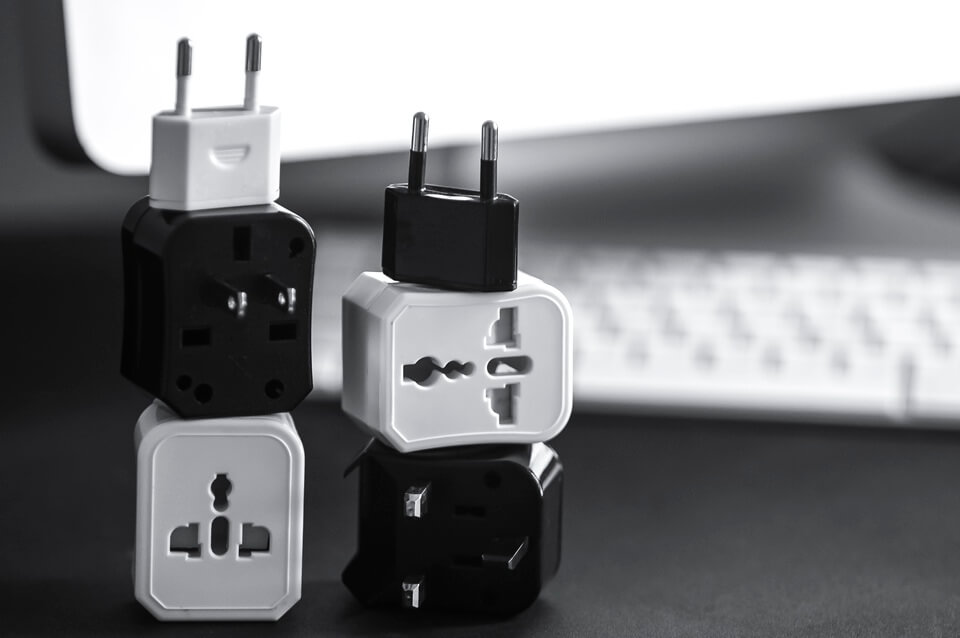
To ensure that your trip to the USA goes well, it’s important to plan everything ahead. To do that, however, you first have to do some research about practical matters such as power adapters…and quite a few other things. Continue reading to find out more.
To make sure, for example, that your personal electrical appliances can be used safely while in the U.S. you might make some adjustments. This will often include using a travel adaptor. This is simply a device that enables you to plug the appliances from your home country into an American electrical socket. What is important to be aware of here is that a travel adapter does not convert the frequency or voltage of the power supply.
There are 2 types of plugs used in the U.S., types A and type B. The former refers to a plug that has 2 flat parallel pins. A type B plug is the one which features 2 flat parallel pins plus a grounding pin. It is also important to know that the United States’ electricity supply operates on 60Hz, while the supply voltage is 120V.
Transformers and voltage converters
If you do a lot of international traveling, you will know that international electricity supply can vary between between 100 Volt and 240 Volt. What you might not know is that it can be very dangerous if the electrical appliance you are trying to use is rated at a different voltage from that of the electricity supply.
Since the voltage of the electricity supply can vary from one country to the next, you may or may not have to use a transformer or voltage converter while visiting the United States. If there is a difference in the frequency, the normal functioning of whatever electrical appliance you are trying to use might also be impacted. A 50Hz electrical clock might, for example, run faster than it should when the electrical supply is 60Hz. The majority of transformers and voltage converters come with a plug adaptor, so you might not have to purchase a new travel adaptor.
All transformers and converters should clearly show their electrical power rating in Watts or Amps. You have to check that the appliance you want to use doesn’t perhaps exceed this maximum rating.
Appliances with a dual voltage rating
It is quite easy to check whether or not you have to use a transformer or converter by simply checking the rating plate of the appliance.
An appliance with a dual voltage rating will, for example, display the power input followed by “110V-240V”. The rating plate will be wither on the appliance’s power supply or on the appliance itself.
If the rating plate, therefore, states 110V-240V, it means that there should be no need for a transformer or converter, an ordinary travel adaptor should do the job. This is because the United States works on a supply voltage of 120V, which falls within the range of 110 – 240V your dual voltage appliance needs to work.
Appliances with a single voltage rating
As we mentioned above, in the United States the voltage of the power supply is 120V. If the appliance you want to use or its power supply are not rates as dual voltage, a single voltage appliance should be used with a converter or voltage transformer to enable the appliance to function properly and safely. This is unless the operating voltage of the appliance is 120V.
It is important to understand that transformers and converters have much the same function, but there are differences in the way they are used. Converters are normally used when the appliance operates for a relatively short time (between 1 and 2 hours). The majority of converters, however, can be used with appliances that remain working continuously.
It is also important that you understand that certain types of travel adaptors should not be used for any appliance that needs an earth connection. You should only use such a travel adaptor with equipment that has double insulation.
More travel tips for your visit to the United States
Communications
The United States’ international dialing code is +1. Certain overseas mobile phones will work in the US but they often have to be 3-band, so it’s best to talk to ask your network provider about international roaming before traveling to the United States. Keep in mind that there will be stores in the majority of large towns and cities in the U.S. where you can buy prepaid phone cards. You can also get a pay-as-you-go mobile phone for the duration of your visit.
The mobile phone service is also often very patchy in the countryside. If you will not be in large towns or cities most of the time, it might be worthwhile to consider satellite phone rental while you are in the U.S.
Insurance and health
The United States does not have something that is very common in most Western countries: a national healthcare system. This means that you will have to pay if you need medical treatment, new prescriptions, or medication. Do not make any mistake, the cost of private healthcare in the U.S. is often exorbitant, even for a fairly small treatment. It is, therefore, very important that travelers should have a good insurance policy to cover the cost of any medical emergencies.
If you have a serious health-related incident while traveling in the U.S., the emergency services will treat you but you will have to foot the bill. If you have a health insurance policy, however, you can claim such costs from the insurance firm.
When considering whether or not to get health insurance, keep in mind that many types of medications that can be bought over the counter in Europe and the UK can only be bought in the U.S. if you have a doctor’s prescription.
Renting a car in the United States
Anyone who wants to rent a car in the U.S. must be able to present a valid driving license as well as official identification that contains a recent photo of him or herself. Also keep in min that you will not be able to rent a car with a card, only with a valid credit card. Your credit card will be swiped by the car rental firm to get authorization for the security deposit in case the vehicle is damaged in an accident of whatever nature.
Sizes and measurements used in the U.S.
In the U.S. weights are measured in tons, pounds, and ounces. Measurements are in miles, yards, feet, and inches. American gallons and pints are about 80% of their imperial counterparts. Clothing sizes, meanwhile, are no less than 4 sizes bigger than their British counterparts. A size 8 dress in the U.S is, therefore, equal to a size 12 one in the UK. Temperatures are measured in Fahrenheit not Celsius. And when you write down a date, the month comes first, followed by the day and finally the year.
Take the right clothing for the right occasion
Since the climate can vary significantly from one part of the U.S.to another, you should pack for all seasons. We recommend taking short sleeved shirts, shorts, trousers, jeans, at least one fleece top, a waterproof jacket, and comfy boots if you intend to do some hiking in the great outdoors.